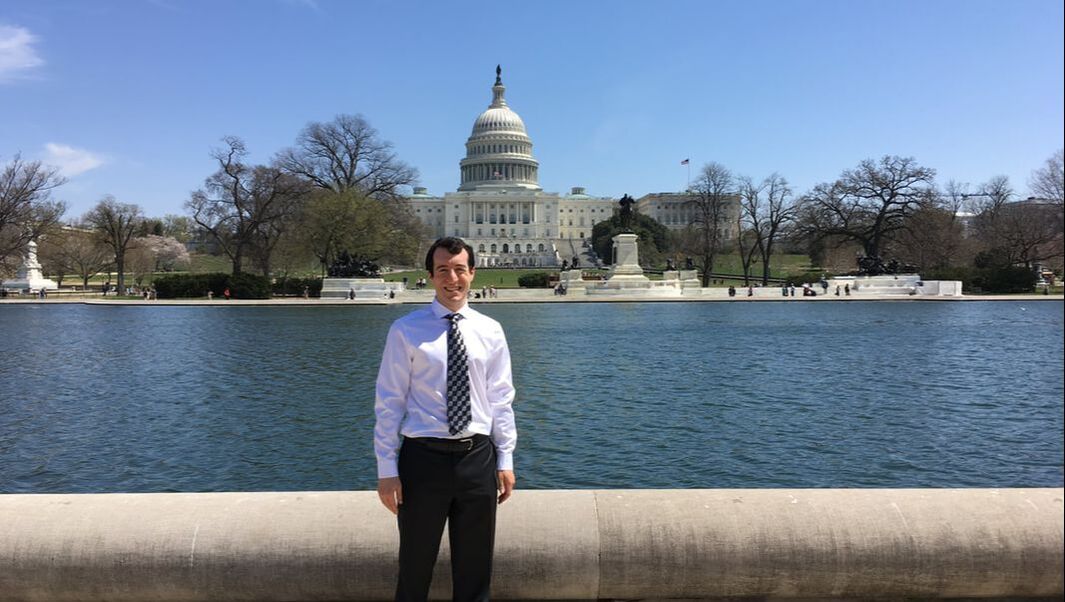
My work as a volcanologist would not have been possible without taxpayer dollars, specifically through the U.S. Department of State's Fulbright Program, the State of Illinois (which provided funding for my University of Illinois Graduate College Fellowship), and the National Science Foundation (which provides funding for my ongoing Graduate Research Fellowship). Moreover, the research that I and countless other scientists conduct cannot benefit our society unless the knowledge that comes from our tireless work guides decision making at all levels of government, from local to federal. For this reason, I am honored to be spending the next 12 months (Sep 2023 - Aug 2024) as a AAAS Congressional Science Fellow sponsored by the Geological Society of America and the U.S. Geological Survey.
For the past six years, I have actively advocated for preserving the indispensable role that science plays in our government's decisions. While serving as the Advocacy Chair for the University of Illinois' Science Policy Group, I organized activities that allowed me and my colleagues to write letters to our Congressional representatives; host energy and agricultural policy panels featuring local elected officials, subject-matter experts, and a Congressional candidate; and visit Springfield, IL to meet with our state representatives. I have also participated in multiple organized visits to Washington, DC to meet with the staff of my Congressional representatives (both in the House and Senate). These trips were made possible by the American Geosciences Institute (AGI), Geological Society of America (GSA), American Association for the Advancement of Science (AAAS), and the American Geophysical Union (AGU). In addition to providing me with first-hand experience communicating with the offices of my Congressional representatives, these DC visits have also allowed me to build a network of like-minded science professionals seeking to communicate the value of our work to broader society.
I am currently a member of GSA's Geology & Public Policy Committee (GPPC), for which I help revise policy position statements that GSA's entire membership (>20,000 individuals) can refer to when preparing for Congressional visits of their own. I am also an alumnus of the American Geophysical Union's Voices for Science program (specifically, their inaugural "policy track" cohort in 2018), and remain in touch with the group to keep up with current science advocacy initiatives.
Below are the science advocacy organizations and workshops I have been directly involved with:
AAAS's Catalyzing Advocacy in Science and Engineering (CASE) workshop
AGI's Geoscience Congressional Visits Days (Geo-CVD)
AGU's Voices for Science program
AGU's Science Policy website
GSA's Position Statements (drafted/revised by GPPC)
UIUC Science Policy Group (SPG)
For the past six years, I have actively advocated for preserving the indispensable role that science plays in our government's decisions. While serving as the Advocacy Chair for the University of Illinois' Science Policy Group, I organized activities that allowed me and my colleagues to write letters to our Congressional representatives; host energy and agricultural policy panels featuring local elected officials, subject-matter experts, and a Congressional candidate; and visit Springfield, IL to meet with our state representatives. I have also participated in multiple organized visits to Washington, DC to meet with the staff of my Congressional representatives (both in the House and Senate). These trips were made possible by the American Geosciences Institute (AGI), Geological Society of America (GSA), American Association for the Advancement of Science (AAAS), and the American Geophysical Union (AGU). In addition to providing me with first-hand experience communicating with the offices of my Congressional representatives, these DC visits have also allowed me to build a network of like-minded science professionals seeking to communicate the value of our work to broader society.
I am currently a member of GSA's Geology & Public Policy Committee (GPPC), for which I help revise policy position statements that GSA's entire membership (>20,000 individuals) can refer to when preparing for Congressional visits of their own. I am also an alumnus of the American Geophysical Union's Voices for Science program (specifically, their inaugural "policy track" cohort in 2018), and remain in touch with the group to keep up with current science advocacy initiatives.
Below are the science advocacy organizations and workshops I have been directly involved with:
AAAS's Catalyzing Advocacy in Science and Engineering (CASE) workshop
AGI's Geoscience Congressional Visits Days (Geo-CVD)
AGU's Voices for Science program
AGU's Science Policy website
GSA's Position Statements (drafted/revised by GPPC)
UIUC Science Policy Group (SPG)
